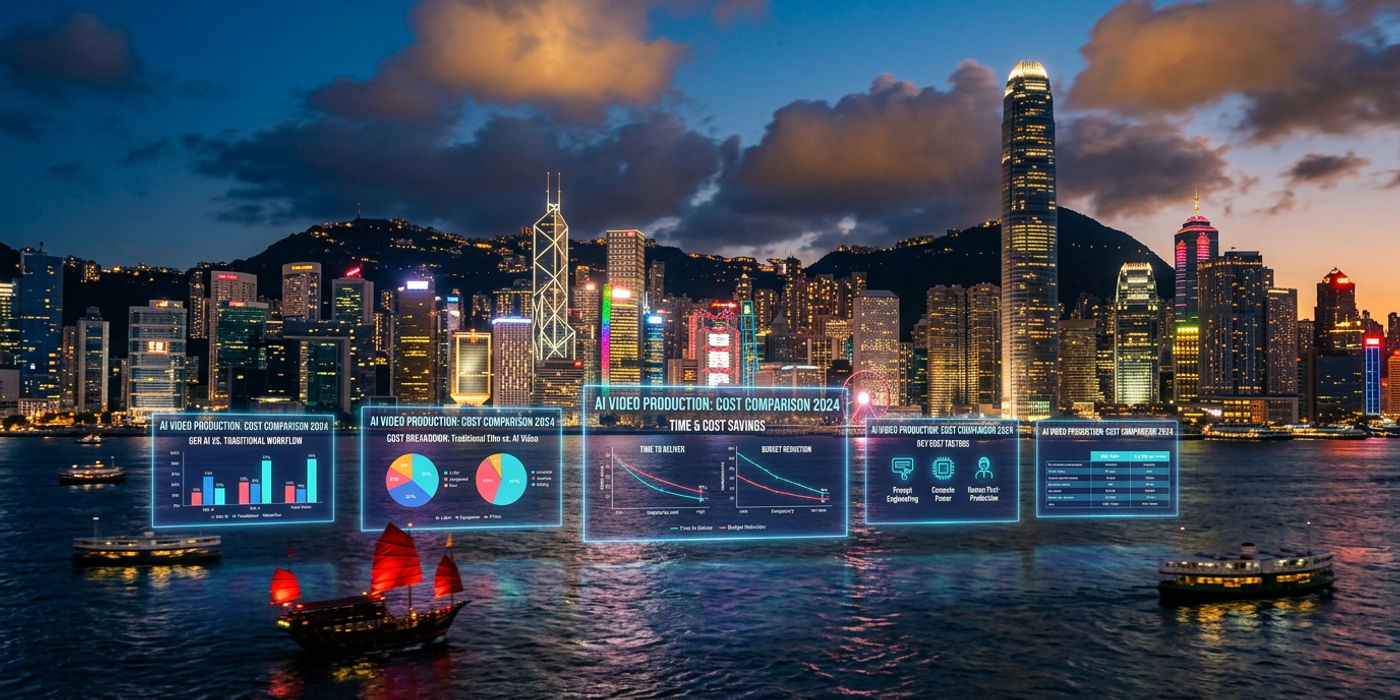
AI video production costs have dropped again in late 2026. From FLUX 3 Video to LTX-2.5, here is the updated cost breakdown for Hong Kong agencies and brands.
How much does AI video production really cost in late 2026? If you looked at the numbers back in June, it is time for an update. The model landscape has shifted fast — FLUX 3 Video went GA with 20-second clips and native audio, LTX-2.5 brought open-weights multi-shot generation with 4K HDR support, and Seedance 2.5 now generates 30-second video in a single pass. Each of these changes rewrites the cost-per-minute equation for Hong Kong creative teams.
Here is the updated cost breakdown for AI video production in late 2026, model by model, with real numbers you can plug into your next budget.
The New Pricing Landscape
The biggest story since mid-2026 is how much cheaper high-quality AI video generation has become. When the original cost guide was published in June, Veo 3.1 and Kling 3.0 were the premium options at roughly HK$120–240 per 5-second clip. Today, competition from FLUX 3 Video, LTX-2.5, and Seedance 2.5 has pushed prices down across the board.
Veo 3.1 remains at the premium end but has improved consistency, reducing the number of regenerations needed. Kling 3.0 dropped its per-generation price by roughly 20% following FLUX 3 Video's GA launch. And the open-weights entrants — LTX-2.5 and FLUX 3 Video — have made self-hosted video generation a realistic option for agencies with GPU infrastructure.
Model-by-Model Cost Breakdown (August 2026)
Veo 3.1 — HK$100–200 per 5-second 1080p generation. Still the benchmark for quality and prompt adherence. A 30-second sequence: HK$600–1,200. Best for client-facing work where quality is non-negotiable.
Kling 3.0 — HK$60–130 per 5-second clip (down from HK$80–160 in June). A 30-second sequence: HK$400–800. Excellent value for social media content and internal pitches.
FLUX 3 Video (GA) — HK$50–120 per 5-second generation, or roughly HK$80–200 for a 20-second native clip. A 30-second sequence using the 20-second mode plus one 10-second extension: HK$120–300. This is the new budget champion for quality output.
Seedance 2.5 — HK$200–400 per 30-second generation (single pass). No clipping needed — one generation, one finished clip. A 30-second sequence: HK$200–400. Ideal for rapid turnaround work where you need full-length video fast.
LTX-2.5 (self-hosted) — HK$0 per generation in API costs, plus GPU compute. Running on a single RTX 4090, a 5-second generation costs roughly HK$5–10 in electricity. A 30-second sequence using multi-shot: HK$30–60. The cheapest option by far, but requires technical setup and GPU hardware.
What HK$5,000 Buys You Today
In June 2026, HK$5,000 in AI video credits got you roughly 25–40 seconds of finished video using Veo 3.1 or Kling 3.0. Today, the same budget stretches further:
- Veo 3.1 only: ~50–60 seconds of finished video (improved consistency means fewer retakes) - Kling 3.0 only: ~75–90 seconds - FLUX 3 Video only: ~90–120 seconds (using the 20-second native clips) - Mixed workflow (Veo for key shots + FLUX for B-roll): ~80–100 seconds of varied-quality footage - LTX-2.5 self-hosted: Essentially unlimited, limited only by render time
For a Hong Kong agency producing 20 social media videos per month, the monthly AI video budget has dropped from roughly HK$15,000–25,000 in June to HK$8,000–15,000 today — a 40% reduction in just three months.
The Hidden Cost Savings
Beyond direct generation costs, three factors have improved the total cost of ownership for AI video production:
Fewer regenerations. Model consistency across all five major tools has improved significantly since June. Where you might have needed 3–4 generations to get one usable clip in mid-2026, you now average 1.5–2. That halves your effective cost per finished second.
Native longer clips. FLUX 3 Video's 20-second mode and Seedance 2.5's 30-second single pass eliminate the need to stitch multiple 5-second clips together. Fewer clips means fewer transitions to edit, fewer colour-matching passes, and less time in post-production.
Open-weights options. LTX-2.5 has made self-hosted AI video a realistic choice for agencies with GPU capacity. The per-second cost approaches zero once the hardware is in place, making it ideal for high-volume B-roll generation and internal content.
Hybrid Production Economics
The smartest strategy in late 2026 remains hybrid production — but the economics have improved on the AI side. A typical hybrid workflow now costs:
- Traditional principal photography: HK$150,000–300,000 (one shoot day, crew, talent) - AI-generated backgrounds, B-roll, and VFX: HK$2,000–5,000 - Total: HK$152,000–305,000 — a 30–40% saving over fully traditional production, with the same quality for hero shots
The AI portion of hybrid budgets has dropped from roughly 10–15% of total production cost in June to 5–8% today.
Frequently Asked Questions
Q: Which AI video model gives the best value for money in late 2026? A: FLUX 3 Video offers the best balance of quality and cost for most Hong Kong creative projects. For maximum savings with technical capability, LTX-2.5 self-hosted is unbeatable per-second.
Q: Has the quality gap between premium and budget models narrowed? A: Yes, significantly. FLUX 3 Video and LTX-2.5 now produce output that competes with Veo 3.1 and Kling 3.0 for most use cases, especially social media and digital advertising.
Q: How much can an agency save per month with the new pricing? A: A Hong Kong agency producing 20 videos per month saves roughly HK$7,000–10,000 compared to June 2026 pricing, assuming the same model mix.
Q: Is self-hosting LTX-2.5 worth it for a small agency? A: Only if you already own a capable GPU (RTX 4090 or better). The setup cost is roughly HK$20,000–25,000 for hardware, which breaks even after 3–4 months of heavy usage.
Q: Does Seedance 2.5 quality match Veo 3.1 for HK advertising? A: Seedance 2.5 excels at longer-form content with consistent style, while Veo 3.1 leads in prompt adherence and cinematic quality. They complement each other rather than compete directly.
Q: What is the fastest AI video workflow for a last-minute client revision? A: Seedance 2.5 for single-pass 30-second generation, or FLUX 3 Video's 20-second mode. Both can deliver a finished clip in under 10 minutes from prompt to export.
Q: Are AI video costs still dropping? A: Yes. The trend line suggests another 20–30% price reduction across API-based models by the end of 2026, driven by open-weights competition and infrastructure efficiency gains.
Q: How do Cantonese voiceover costs fit into the AI video budget? A: AI Cantonese voice generation costs roughly HK$15–40 per minute in late 2026, down from HK$20–50 in June. This adds approximately HK$8–20 to a typical 30-second video.