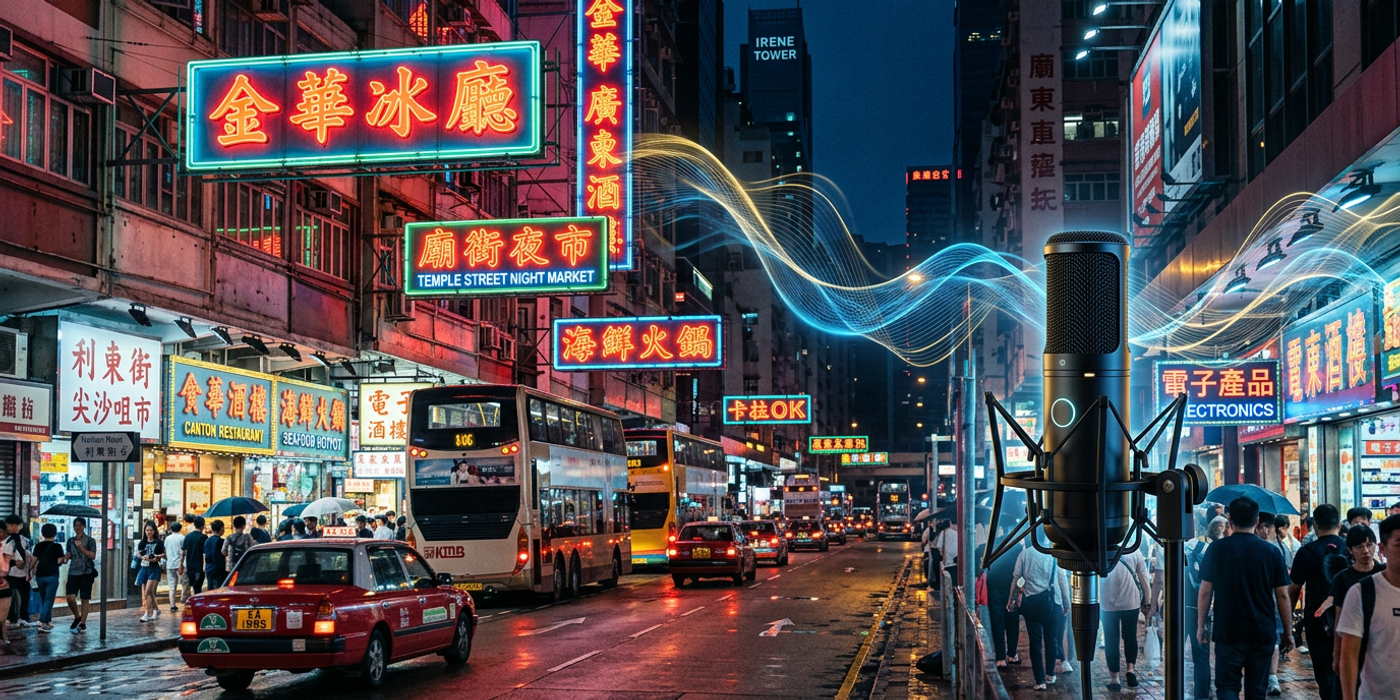
Discover how AI voice generation is transforming Cantonese-language content creation for Hong Kong businesses, educators, and creators — from natural voiceovers to bilingual marketing.
Cantonese is the heart of Hong Kong's identity — spoken by over 85 million people worldwide. But if you've tried generating AI voiceovers in Cantonese, you know the struggle: robotic delivery, wrong tones, and an unmistakable "mainland accent" that kills authenticity.
That's changing fast. AI voice generation has made massive strides in Cantonese in 2026, and the implications for Hong Kong creators, marketers, and businesses are huge.
Here's how Cantonese-language content stands to benefit from modern AI voice technology — and how you can start using it today.
Why Cantonese Is Harder for AI Than Mandarin
Most AI voice models were trained on Mandarin first. Cantonese is fundamentally different — it has six to nine tones (depending on how you count), while Mandarin has four. Getting those tones right is non-negotiable. Say sik1 (食, "eat") with the wrong pitch and a Cantonese listener hears sik6 (蝕, "lose") instead.
Beyond tones, Cantonese has: - Different vocabulary — 佢 (keoi5) vs 他 (tā), 唔該 (m4 goi1) vs 謝謝 (xièxie) - Different grammar — 我大過你 vs 我比你大 ("I'm older than you") - Final particles — 啦 (laa1), 囉 (lo1), 呀 (aa3) that carry emotional nuance - Code-switching — natural Cantonese speakers freely mix English words
Early TTS engines flattened all of this. Modern AI models handle it much better by training on actual Cantonese speech data — conversations, news broadcasts, and even YouTube content from Hong Kong creators.
Use Case 1 — Voiceovers for Hong Kong Marketing
Hong Kong brands spend heavily on video ads, but professional Cantonese voiceover talent is expensive and booked out. A 30-second commercial voiceover can cost HK$3,000–HK$8,000 per take. For a campaign with 10 variations? That adds up fast.
AI Cantonese voice generation lets you: - Produce voiceovers in minutes, not days - Iterate on tone and delivery without rebooking talent - A/B test different voices for the same ad script - Localize ads for specific HK demographics — younger voices for social, authoritative ones for corporate
The key is choosing a model that understands Cantonese prosody — not just the words but the rhythm. Some newer models can even deliver the classic Cantonese "sentence-final particle" nuance that makes speech feel genuinely local.
Use Case 2 — Bilingual Content (English + Cantonese)
Hong Kong's bilingual nature means most professional content needs both languages. With AI voice generation, you can create a single script that seamlessly switches between English and Cantonese — exactly how Hongkongers actually speak.
This is huge for: - Corporate training videos that explain concepts in English then reinforce in Cantonese - Real estate walkthroughs targeting both expats and local buyers - Educational content where technical terms stay in English with Cantonese explanations - Social media ads that code-switch naturally to build relatability
A single AI pipeline can render both language tracks in matching voices, maintaining consistent brand identity across languages.
Use Case 3 — Accessibility and Inclusivity
Cantonese AI voice isn't just for marketing. It's making digital content more accessible: - Screen readers that actually read Cantonese properly (a long-standing gap) - News-to-speech for visually impaired Cantonese speakers - Cantonese-language learning apps with perfect tonal pronunciation - Customer service chatbots that answer in natural Cantonese instead of written Chinese
For Hong Kong's elderly population — many of whom are more comfortable with spoken Cantonese than written Chinese — AI voice generation bridges a real accessibility gap that standard text interfaces can't solve.
Use Case 4 — Cantonese Content for Global Audiences
Hong Kong has one of the world's largest diaspora communities — over 500,000 Hongkongers moved abroad between 2019 and 2025. Cantonese AI voice helps diaspora creators and businesses produce content for these communities without needing in-studio talent in every city.
A Hong Kong restaurant in London can produce Cantonese-language social media content. A Hong Kong news outlet can serve its Vancouver readership with the same voice quality as local programming. AI voice generation makes geographic distribution frictionless.
How to Get Started with Cantonese AI Voice on Cooly Studio
Cooly Studio supports Cantonese text-to-speech through multiple AI voice models. Here's a quick workflow:
1. Write your script in Jyutping or characters — the latest models handle both 2. Select a Cantonese-capable voice from the voice library 3. Adjust tone, speed, and emphasis — dial in the natural Hong Kong cadence 4. Preview and iterate — generate multiple takes in seconds 5. Export and use — download as MP3 or integrate directly into your video pipeline
The quality gap between generic TTS and Cantonese-specific models is significant. If your audience is Hong Kong Cantonese speakers, always test with a model that was trained on Hong Kong Cantonese — not mainland Cantonese or generic Chinese data.
The Bottom Line
AI voice generation for Cantonese has crossed the "good enough" threshold and is approaching professional studio quality. For Hong Kong businesses producing video content, the savings in time and cost are real — and the ability to iterate and experiment freely unlocks creative options that were previously too expensive to explore.
Whether you're producing a TV commercial, a YouTube tutorial, or an internal training video, Cantonese AI voice is ready for prime time.
Frequently Asked Questions
Q: Can AI voice generation handle Cantonese tones correctly? A: Modern AI models have significantly improved tonal accuracy. Models trained on Hong Kong Cantonese speech data can correctly differentiate tones like sik1 (食) and sik6 (蝕). However, complex sentences with multiple tonal shifts still occasionally need correction — always preview before publishing.
Q: How much does AI Cantonese voiceover cost compared to a human voice actor? A: AI voice generation costs a fraction — typically HK$10–HK$50 for a 60-second voiceover on Cooly Studio, compared to HK$3,000–HK$8,000 for professional human talent. For high-stakes brand campaigns, a hybrid approach (AI rough cuts + human final take) is common.
Q: Does AI voice support Cantonese-English code-switching? A: Yes, the latest Cantonese TTS models can handle mixed-language scripts. You write naturally — "我哋今日要discuss呢個campaign嘅strategy" — and the AI renders it with appropriate pronunciation for each language segment.
Q: Can I use AI Cantonese voice for commercial projects? A: Absolutely. Cooly Studio grants commercial usage rights for all AI-generated voiceovers. Always check individual model licensing, but standard terms cover advertising, social media, and corporate content.
Q: What's the difference between Cantonese and Mandarin AI voices? A: They use entirely different training data and phonetic models. A Mandarin TTS model speaking Cantonese will sound like a mainland speaker — wrong vocabulary, wrong particles, and flattened tones. Always use a Cantonese-specific model for Hong Kong audiences.
Q: How long does it take to generate a Cantonese voiceover? A: A 60-second voiceover typically generates in 10–30 seconds on Cooly Studio. Batch processing multiple takes is also supported, making it practical to generate voiceover variations for A/B testing.
Q: Can I clone my own voice in Cantonese? A: Some platforms support Cantonese voice cloning, though quality varies. For most business use cases, selecting from curated Cantonese voice profiles is more reliable. Voice cloning introduces ethical and legal considerations — always obtain explicit consent.
Q: Is AI Cantonese voice good enough for broadcast TV? A: For most broadcast applications, human voice actors still deliver superior emotional nuance and consistency. But AI Cantonese voice is excellent for digital-first content, social media, training materials, and internal communications where speed and budget matter more than perfection.