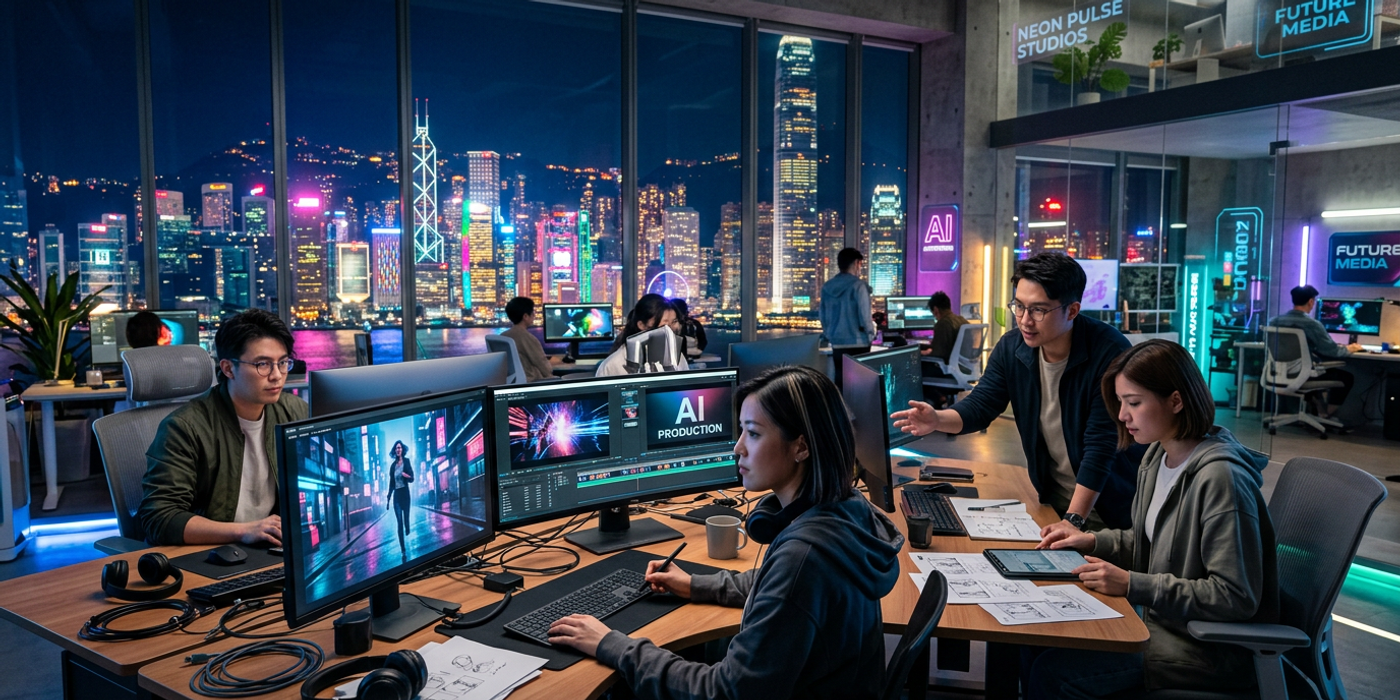
Hong Kong advertising agencies are adopting AI video tools at record pace in 2026. From Veo 3.1 to Kling 3.0, here's how the city's top creative shops are cutting production time and costs.
Hong Kong advertising agencies have never been shy about adopting new technology. In 2026, the buzz isn't about blockchain or the metaverse — it's about AI-generated video. From Causeway Bay to Wong Chuk Hang, creative shops of every size are rewriting their production playbooks.
The shift is real. Agencies that spent months on a single 30-second TV spot are now turning around campaigns in days. Clients like HSBC, the Hong Kong Tourism Board, and Lee Kum Kee are asking for AI-powered work — and the agencies delivering it are winning the pitches.
Here's how Hong Kong agencies are actually using AI video in 2026, what's working, and what's still a work in progress.
Pre-visualisation and client pitches
The biggest time-saver for Hong Kong agencies? AI video for pre-vis. Instead of spending HK$50,000-100,000 on a test shoot or elaborate animatic, production teams now storyboard entire commercials with tools like Veo 3.1 and Kling 3.0 in a single afternoon.
A creative director at a Central-based agency told us: "We used to need three weeks and approval from three layers of management just to get a look-and-feel reel. Now I type a prompt, generate five options before lunch, and walk into the pitch with something the client can actually react to."
This changes the dynamic. Clients see real footage — not placeholder sketches — and give tighter feedback. The agency saves budget for the actual production, and the brief gets locked faster.
Rapid iteration for social media content
Hong Kong's fast-paced media landscape demands volume. A typical campaign might need 15-20 short-form videos for Instagram Reels, YouTube Shorts, and Little Red Book — all with different aspect ratios and durations.
Agencies are batch-producing these with AI video workflows. Here's the typical pipeline:
1. Reference shot selection — pick the hero footage from a traditional shoot or stock library 2. Image-to-video generation — use Kling 3.0 or Seedance to turn static frames into motion clips 3. Multi-format export — crop and adapt for vertical (9:16), square (1:1), and horizontal (16:9) 4. Voiceover layer — add AI-generated Cantonese or Mandarin voiceovers with natural tone and pacing 5. Final polish — composite in Premiere or DaVinci Resolve with brand elements
What used to take a team of three over two weeks now takes one editor two days. The quality gap? Shrinking fast. Most viewers can't tell the difference between a Kling 3.0 clip and footage shot on a RED camera, especially on a phone screen.
Cost arbitrage: AI video vs traditional production
Hong Kong's production costs are among the highest in Asia. A day rate for a decent DP runs HK$8,000-15,000. Add a producer, lighting crew, stylist, location fees, catering — a two-day commercial shoot easily hits HK$200,000-400,000 before post-production.
AI video doesn't replace the high-end stuff yet. But it handles a growing middle tier:
| Production type | Traditional cost | AI-assisted cost | Time saving | |:---|---:|---:|---:| | 30s social media spot | HK$80,000-150,000 | HK$15,000-30,000 | 70-80% | | Product demo video | HK$50,000-100,000 | HK$10,000-20,000 | 75-85% | | Campaign mood reel | HK$100,000-200,000 | HK$8,000-15,000 | 85-90% | | Internal training video | HK$30,000-60,000 | HK$5,000-10,000 | 80-85% |
The savings are meaningful — especially for mid-sized agencies where margins are tight. One agency we spoke to redirected HK$500,000 in annual production savings into creative strategy and talent development.
Brand consistency at scale
The early knock on AI video was that it felt random. Every generation was a surprise. That's changed in 2026.
Tools like Cooly Studio let agencies control style, lighting, character appearance, and even brand colour palettes across hundreds of generations. Reference image workflows (IP-Adapter, image-to-video conditioning) mean the AI understands what your brand looks like — not just what you describe in a prompt.
Agencies serving luxury brands (think hospitality, fine dining, high-end retail) are using this to produce consistent lifestyle imagery at scale. The same poolside scene, the same product shot, the same model — generated in different angles and contexts — without booking a single location or talent.
Cantonese and bilingual content workflows
This is where Hong Kong agencies have a genuine edge over their global competitors. Most AI voice and video tools are English-first, but the local market demands Cantonese content.
Forward-thinking agencies are building custom workflows: - Generate the video visuals in any AI video tool - Layer Cantonese voiceovers using tools that support Jyutping romanisation or direct Cantonese TTS - Add bilingual captions (Chinese + English) using AI subtitle generation - Export in WeChat and WhatsApp-optimised formats
Cooly Studio's multi-model approach means you can generate the visuals with Veo 3.1, add voice with a TTS model, and composite — all in one platform. This is a genuine differentiator for agencies pitching bilingual campaigns to the HKTB, MTR, or major property developers.
The human talent question
Will AI video replace Hong Kong's production crews? Short answer: no. But the roles are changing.
Editors who only cut are becoming editors who write prompts. DPs who only shoot are becoming creative technologists who know both lighting theory and model parameters. The agencies hiring best in 2026 are the ones investing in hybrid talent — people who can talk to a client about brand strategy and then generate the video themselves.
One agency CEO put it bluntly: "I'm not hiring junior editors anymore. I'm hiring prompt engineers who also know how to edit. The assistant editor role is disappearing. The 'AI + craft' role is the new standard."
What the next 12 months look like
Hong Kong agencies are still early in the AI video curve. Most shops have experimented. The ones winning are the ones systematising: - Building prompt libraries for recurring client brands - Training teams on model selection (Veo for realism, Kling for stylised, Seedance for speed) - Establishing quality checkpoints between AI generation and final delivery - Measuring client satisfaction on AI-assisted vs traditional work
By mid-2027, AI video will be table stakes — not a differentiator. Agencies that don't have a repeatable AI production workflow by then will struggle to compete on either price or speed.
Frequently Asked Questions
Q: Is AI video quality good enough for Hong Kong TV commercials? A: For broadcast television and cinema, traditional production still leads on resolution and colour depth. But for digital-first campaigns — YouTube pre-roll, Instagram, OTT platforms — AI video at 1080p is already competitive. Many agencies now use AI for the raw footage and human post-production for the final polish.
Q: Which AI video models are Hong Kong agencies using most? A: The top three in 2026 are Veo 3.1 (best photorealism), Kling 3.0 (best stylised motion), and Seedance (best turnaround speed). Each has strengths — most agencies use a mix depending on the brief.
Q: How much can an agency save by switching to AI video? A: For social media and mid-tier production, savings are 70-85% compared to traditional shoots. A HK$100,000 social campaign can be produced for HK$15,000-30,000 with AI assistance. High-end hero content still commands traditional budgets.
Q: Does AI video work for Cantonese-language content? A: Yes, with the right workflow. Generate the visuals in any AI video model, then layer Cantonese voiceovers using TTS tools. Bilingual captioning (Chinese + English) is straightforward with current AI tools. Cooly Studio makes this multi-step process much smoother.
Q: What's the biggest mistake agencies make with AI video? A: Expecting it to work perfectly on the first try. AI video requires iteration — generating multiple takes, refining prompts, and compositing results. Treating it like a magic button leads to disappointment. Treating it like a faster production pipeline leads to great work.
Q: Will AI video replace human video producers? A: Not entirely, but roles are evolving. Junior editing positions are shrinking. Hybrid roles — part prompt engineer, part editor, part creative technologist — are growing. The producers and DPs who learn AI tools alongside their craft are the ones in highest demand.
Q: How do agencies pitch AI video work to conservative clients? A: Start with pre-vis. Show AI-generated mood reels before the shoot, not final deliverables. Let the client see the speed and iteration value firsthand. Once they trust the quality, they'll ask for AI in the final production too.
Q: What should an agency budget for AI video tools in 2026? A: A reasonable monthly spend for a mid-size agency is HK$5,000-15,000 across model credits, platform subscriptions, and Cloud GPU time. Cooly Studio offers a consolidated platform that covers multiple models, so agencies save on managing separate subscriptions.