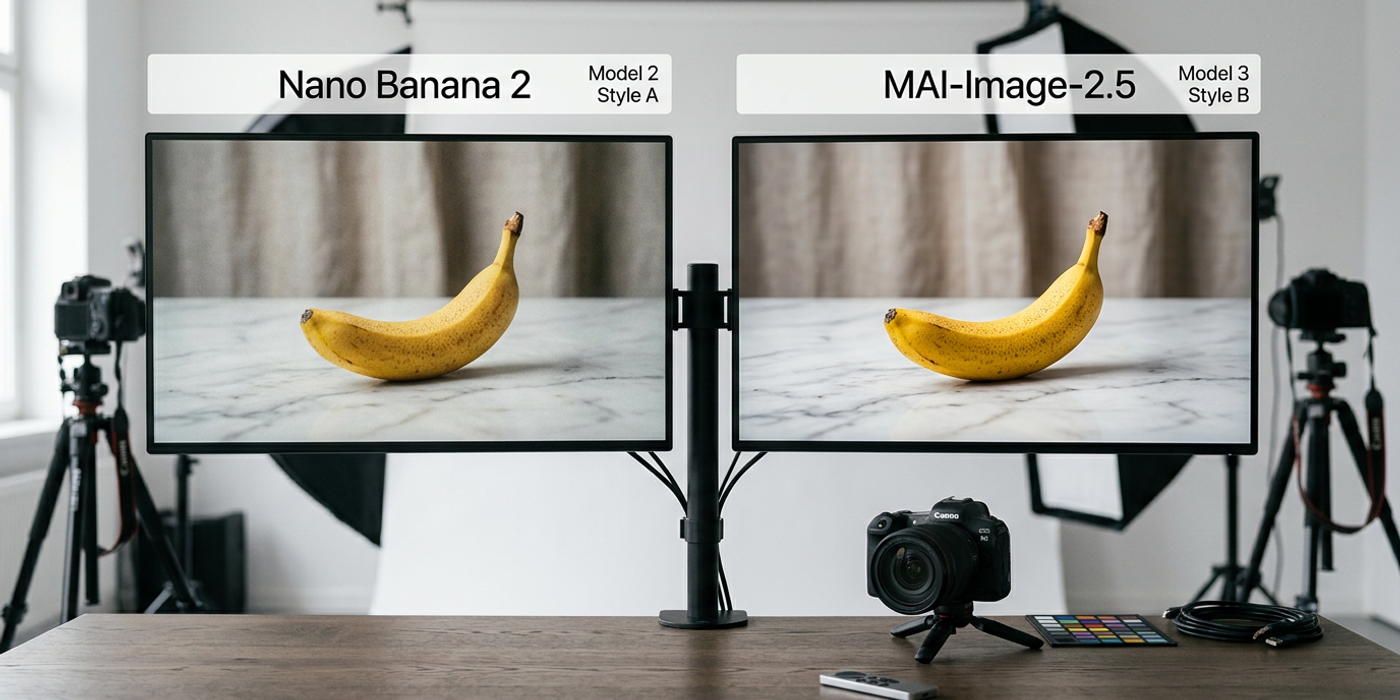
Microsoft's MAI-Image-2.5 is now ranked #3 on the Arena leaderboard, pulling even with Google's Nano Banana 2. Here's what HK creators and agencies need to know.
Microsoft just dropped MAI-Image-2.5, and the numbers are turning heads. The latest entry in Microsoft's MAI image model family has hit #3 on the Arena text-to-image leaderboard — pulling even with Google's Nano Banana 2 and landing just behind OpenAI's Image-2.
For Hong Kong creators and agencies who've been comparing AI image tools, this changes the conversation. Here's why.
What's New in MAI-Image-2.5
Microsoft is calling MAI-Image-2.5 its strongest image model yet, and the benchmarks back it up. According to the MAI team, the model delivers major gains over MAI-Image-2 in three critical areas:
Text rendering. This has been a weak spot for many AI image models — struggling to render readable text inside generated images. MAI-Image-2.5 makes a notable leap here, which matters for ad mockups, social media graphics, and brand assets where text legibility is non-negotiable.
Stylized illustrations. The new model handles artistic styles with more sophistication — from watercolour to vector art to comic book looks. For agencies producing concept art or mood boards, this opens more creative range without switching tools.
Commercial visuals. This is the big one. Microsoft is positioning MAI-Image-2.5 directly for product photography and brand design workflows. The model produces more consistent lighting, better depth, and cleaner spatial relationships — exactly what you need when generating e-commerce assets or campaign mockups.
How It Stacks Up Against Nano Banana 2
If you've been following Cooly Studio, you know Nano Banana 2 has been a go-to for fast, photorealistic image generation. MAI-Image-2.5 now matches it on the leaderboard, but the two models approach quality differently:
- Nano Banana 2 excels at speed and photorealism — great for rapid iteration and natural-looking images - MAI-Image-2.5 shines in text rendering and structured commercial compositions — better for branded content where layout and legibility matter
This isn't a clear "winner" situation. It's more like having two strong options depending on your use case. For portrait photography and natural scenes, Nano Banana 2 still leads. For product shots and brand materials, MAI-Image-2.5 is now a serious contender.
What This Means for Hong Kong Creators
For agencies working with HSBC, HK Tourism Board, and Lee Kum Kee — or any brand that needs polished commercial imagery — having another top-tier option is good news. More competition means better results and lower costs across the board.
At cooly.ai, we're watching this closely. The MAI-Image-2.5 launch shows that the AI image generation space is moving fast. Models that were leading two months ago are now fighting to stay competitive. For creators, that means the tools keep getting better — and the bar for quality keeps rising.
Should You Switch?
Not necessarily. If your workflow with Nano Banana 2 or Seedream 4 is delivering the results you need, there's no rush. But if you're pushing into commercial product photography, branded content, or any project where text-in-image quality matters — MAI-Image-2.5 is worth testing.
Frequently Asked Questions
Q: Is MAI-Image-2.5 available on Cooly Studio? A: Not yet — but as Cooly Studio adds new models, MAI-Image-2.5 is a strong candidate. Stay tuned for updates.
Q: How does MAI-Image-2.5 compare to OpenAI's Image-2? A: Image-2 still holds the #1 spot on Arena. MAI-Image-2.5 is competitive but not quite there yet — especially in creative composition and fine detail.
Q: Is this a free model or paid? A: Microsoft offers MAI-Image-2.5 through its MAI Playground and Azure Foundry. Pricing details are still emerging as the model rolls out.
Q: What kinds of images does MAI-Image-2.5 handle best? A: Product photography, branded commercial visuals, stylized illustrations, and images requiring legible text rendering.
Q: Does MAI-Image-2.5 support negative prompts? A: Yes — like most modern AI image models, it supports negative prompting to exclude unwanted elements from generations.