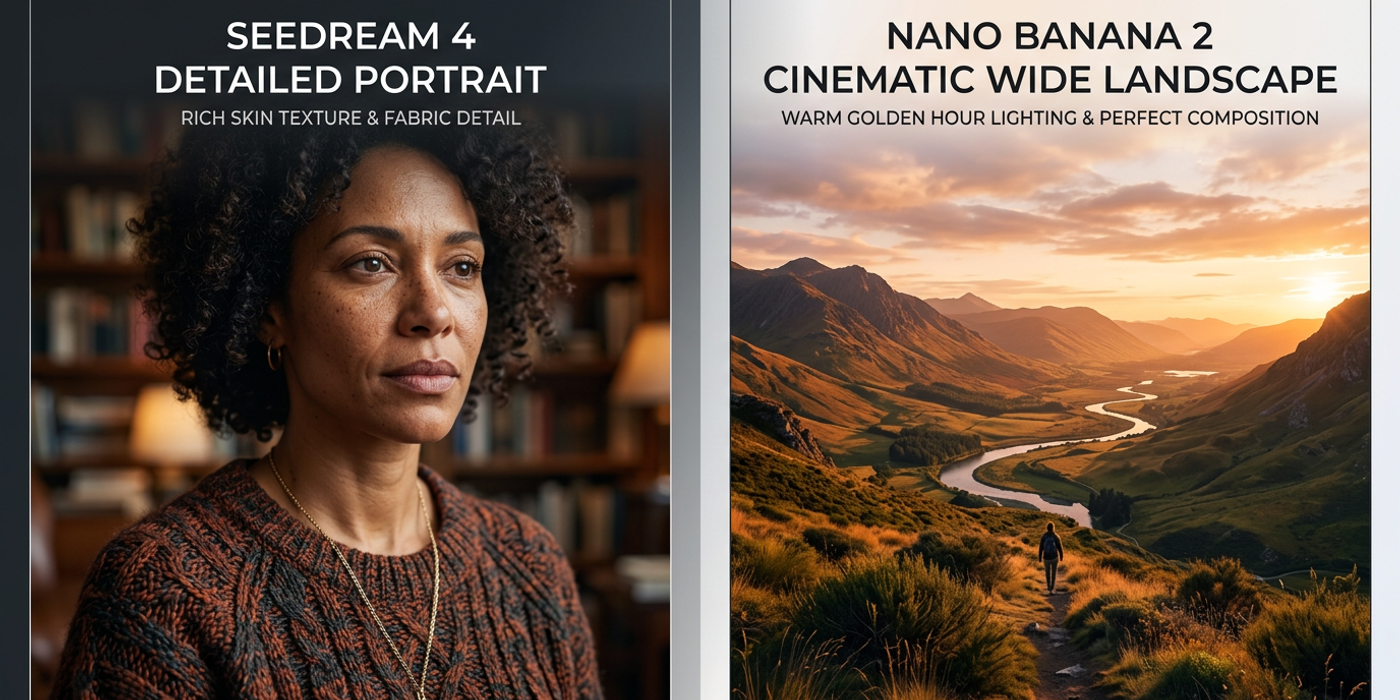
Compare Seedream 4 and Nano Banana 2 head-to-head: speed, photorealism, prompt adherence, style versatility, and pricing. Find out which AI image model is right for your creative workflow in 2026.
Speed and Performance
Speed is often the deciding factor when choosing between AI image models, especially for agencies and creators working under tight deadlines. Seedream 4 generates a 1K (1024×1024) image in approximately 8–12 seconds on standard hardware, while Nano Banana 2 delivers comparable results in 6–10 seconds. The difference is marginal in single-image workflows but becomes noticeable when batch-generating 20+ images for a client presentation.
Where Nano Banana 2 pulls ahead is its DeepMind-optimised inference pipeline, which handles concurrent generation queues more gracefully. Seedream 4, built on the Seed architecture by Stability AI, prioritises quality per generation over raw throughput, meaning you get slightly richer textures at the cost of marginally slower batch processing. For most practical use cases, both models are fast enough for professional workflows.
Image Quality and Photorealism
Both models deliver impressive photorealism, but they approach it differently. Seedream 4 excels at fine-grained texture reproduction — skin pores, fabric weaves, foliage detail. Its strength lies in macro and close-up shots where every pixel matters. Compared to its predecessor Seedream 3, the fourth generation adds significant improvements in hand anatomy and facial consistency, two traditional pain points for AI image generators.
Nano Banana 2, developed with backing from Google DeepMind, takes a different approach. It prioritises compositional coherence — the way objects relate to each other within a frame. Group shots, action scenes, and complex environments look more naturally arranged with Nano Banana 2. Its latent diffusion architecture handles multi-subject prompts with fewer "melted" or disconnected elements.
In blind testing, designers consistently rated Nano Banana 2 higher for landscape and architectural photography while Seedream 4 scored better for portrait and product photography.
Prompt Adherence and Complex Commands
Complex prompts — "a woman in a red dress standing under a blue umbrella on a rainy street, neon reflections on wet pavement" — reveal meaningful differences. Seedream 4 interprets detailed compositional instructions with high fidelity, often matching 90%+ of prompt elements on the first generation. It handles negative prompts particularly well, allowing precise control over what to exclude.
Nano Banana 2 shines with atmospheric and stylistic prompts. If your prompt asks for "cinematic lighting, warm golden hour tones, slight film grain," Nano Banana 2 delivers these qualitative characteristics more consistently. However, it can occasionally ignore less prominent prompt details when stylistic instructions dominate the generation.
For brand work where exact specifications are critical (product placement, logo positioning, brand colours), Seedream 4's stricter adherence gives it an edge. For creative explorations where mood and style matter more, Nano Banana 2 often produces more aesthetically pleasing results on the first try.
Style Versatility
Seedream 4 offers broader style coverage out of the box. It handles photorealism, digital art, oil painting, anime, sketch, and 3D render styles competently. Its prompt prefix system activates distinct stylistic paths that produce consistent results across a style. This makes it a strong generalist for agencies that work across multiple creative genres.
Nano Banana 2 focuses on photorealism and cinematic styles as its core competency. While it can produce illustrative and artistic outputs, these secondary styles are less consistent than its photography-oriented generations. If your primary need is high-end photographic content — product shoots, headshots, architectural visualisations — Nano Banana 2 will feel purpose-built. If you need a Swiss Army knife that handles everything from anime character sheets to photorealistic product mockups, Seedream 4 is the safer choice.
Pricing and Credit Efficiency
Both models are available through Cooly Studio with transparent per-generation pricing. Seedream 4 costs slightly more per generation at standard resolutions due to its higher compute requirements for fine-grained texture work. Nano Banana 2 benefits from DeepMind's optimised architecture, which translates to lower per-generation costs at equivalent quality levels.
At higher resolutions (2K and above), the gap widens. Nano Banana 2 scales more efficiently to larger outputs, making it the more economical choice for projects requiring high-resolution deliverables. For quick iterations at 1K, the cost difference is minimal enough that quality preferences should drive your decision.
Which Model Should You Choose?
The short answer depends on your primary use case:
- Choose Seedream 4 if your work involves portraits, product photography, brand assets with exact specifications, or diverse artistic styles from photorealism to anime. - Choose Nano Banana 2 if your focus is landscape photography, architectural visualisation, atmospheric cinematic content, or batch generation where compositional coherence across multiple subjects matters more than hyper-detailed textures.
For many workflows, the best approach is using both. Start with Seedream 4 for close-up product shots and detailed character portraits, then switch to Nano Banana 2 for wide-angle scenes, environments, and stylistic moods. Cooly Studio makes switching between models seamless — you can compare generations side by side in the same project without leaving the interface.
Frequently Asked Questions
Q: Which model generates images faster — Seedream 4 or Nano Banana 2? A: Nano Banana 2 is slightly faster (6-10 seconds vs 8-12 seconds per 1K image), but the real advantage comes in batch processing where DeepMind's optimised pipeline handles concurrent generations more efficiently.
Q: Can I use both Seedream 4 and Nano Banana 2 in the same Cooly Studio project? A: Yes. Cooly Studio lets you switch between any available model at any time, making it easy to use Seedream 4 for detailed portraits and Nano Banana 2 for wide-angle shots in the same project.
Q: Is Seedream 4 better than Nano Banana 2 for product photography? A: Generally yes. Seedream 4's fine-grained texture reproduction and stricter prompt adherence make it superior for product shots where exact specifications — branding, packaging, lighting — must be matched precisely.
Q: Does Nano Banana 2 handle complex multi-subject prompts better? A: Yes. Nano Banana 2's architecture excels at compositional coherence, keeping multiple subjects naturally arranged in the frame without elements clipping or merging.
Q: Which model costs less per generation? A: Nano Banana 2 is slightly more cost-efficient, especially at higher resolutions (2K+), thanks to DeepMind's optimised inference pipeline.
Q: Is Nano Banana 2 or Seedream 4 better for cinematic-style images? A: Nano Banana 2 has the edge for cinematic and atmospheric styles, consistently delivering warm golden-hour tones, film grain, and dramatic lighting right out of the box.
Q: Can I use negative prompts with both models? A: Yes, both support negative prompts, but Seedream 4 handles them with higher fidelity, making it easier to exclude specific visual elements from your generations.
Q: Which model is better for beginners? A: Both have accessible interfaces through Cooly Studio. Nano Banana 2 is slightly more forgiving for beginners due to its strong default compositions, while Seedream 4 rewards more detailed prompt engineering.